BPF
  • Home
  • BPF Blog
  • Appraisal
  • Personalism
  • About Us
    • Join as a Member
    • Donate
    • Contact Us
Picture
Appraisal Home
Current Issue
Past Issues
LETTERS TO THE EDITOR
Editorial Team
Guide for authors
supporting open access
add comment to article

Appraisal Volume 13, No. 1, Spring 2023

​ISSN 2514-5584​

Book Review

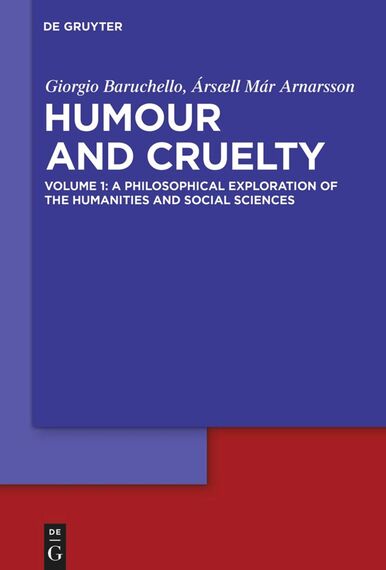
Giorgio Baruchello and Ársæll Már Arnarsson​
Humour and Cruelty Volume 1: A Philosophical Exploration of the Humanities and Social Sciences
In the series De Gruyter Studies in Philosophy of Humor

Berlin, De Gruyter, 2022, xiii and 531 pp.
ISBN: 9783110759761 hardcover, 9783110759839 ebook.
Picture
To read this book is to take a series of deep-dives into oceans of historical literature on both topics, each dive fascinating on its own. Considered together, I find them particularly rich food for thought, in that what makes things funny or cruel seems to suggest something distinctive about us. Arguably, we alone among the world's creatures find things funny or cruel, so it is worth considering what it is about us that makes that true. 

There are, then, at least two fruitful ways to use this book. One can consult it as an encyclopaedia, and one can read it through to reach philosophical conclusions about our personal nature. 

As an encyclopaedia, the book offers diverse theories about, perspectives on, and approaches to humour and cruelty. Want to know about what humour was like in Addison's 18th Century London daily, The Spectator? It is covered: pp. 48-55. Interested in the Isotopy-Disjunctive model of how jokes work? Or in discovering what cruelty meant to the Marquis de Sade? Or, in what psychologists say about cruelty today? A sub-chapter is devoted to these topics too. 

The book is well-ordered to function as a reference manual because its two halves, humour and cruelty, are each divided into a philosophy and humanities section and another on psychology and the social sciences. The authors enjoy something of that division of labour as well. Baruchello is a philosopher; Arnarsson, a biological psychologist.

It soon became apparent to this reader how useful it can be to consider each topic from each of these two clusters of disciplinary perspectives. But it was not immediately clear—and even now not entirely clear—why the authors chose to treat them in the same book. What do humour and cruelty have to do with one another? In this volume, their relationship is sometimes noted—that humour can be cruel, for instance—but no systematic account of their kinship is developed. That is by intent. Humour and Cruelty, it turns out, is the first of three volumes. The second and third, forthcoming, will show the two in conjunction—humorous cruelty and cruel humour—and in conflict—'the use and abuse of cruelty against humour, and…of humour against cruelty.' They are, respectively, Dangerous Liaisons and Laughing Matters. Humour and Cruelty stands complete as a survey of each topic independently; the next two volumes promise to explore their interface.

The second way to read this book is to use it as a foil for the features of agency that make it personal. This approach intrigues me, particularly with reference to humour. It is, as I said, a uniquely human trait, and that alone seems suggestive. But what if anything does our ability to find things humorous tell us about how we persons give meaning to our action, and what if anything do the distinctive ways we characterize action tell us about humour?

Baruchello and Arnarsson do not address the issue as I have framed it, at least not directly. But they do address it indirectly by how they assess what they find in their 'dives.' In an assumption they make, they are able to turn the two topics into portals into what it means to be a person. The crucial assumption is that all knowledge is personal, including knowing whether something is meant to be humorous or cruel.

As Michael Polanyi uses the term 'personal knowledge,' there is a tacit coefficient to any grasp of the meaning of anything, from a scientific theory to a joke. By operating with that Polanyian epistemology, the authors can account for a crucial formal feature of the meaning of anything we find humorous, namely its polysemy. Polysemy is a systematic ambiguity in meaning. It is meaning that cannot be disambiguated and still be understood. Humour is multi-layered in meaning in that it puts us in multiple active contexts at once, often incongruous ones. 'Humour' therefore has 'measured fluidity.' (For brevity's sake and because I find their treatment of the topic more thought provoking, I am focusing here mostly on the humour part of the book.)

The first thing to say about the claim that 'humour is polysemic' is that the claim is itself polysemic. It means both that if we are aware of something as humorous, we find it to be meaningful in more than one way, and it means that the word 'humour' has multiple means. By occasionally reminding us of polysemy of both kinds, the authors maintain a consistent and clear perspective on the accounts they study. Each exploration takes us not only into an exotic world in its own terms, but it assesses its account at least partly according to whether it accommodates the polysemy of humour.

As our explorations of the various accounts add up, we observe that many of the humanists and scientists weighing in on the topic in the past tried and failed to grasp the nature of humour adequately because they did not accommodate its systematic ambiguity. Psychologists, for example, need clear definitions and quantifiable subject matter. Much the same can be said for social scientists. As the authors observe, the polysemy of humour has either tended to discourage them from working on the topic or, for those who have engaged it, at best to illuminate only a facet of it.

In reading this book, I have come to see why humour can be understood best if we recognize the role of personal knowledge and why persons can only reach their personal potential if they have a sense of humour. To flesh out my conclusions, let me highlight some commonalities that emerged for me as I read. These suggest themselves as tenets of personalism, though the book does not explicitly state all of them.

1) Like humour, persons cannot be identified conceptually. I mentioned earlier that the dominant ways to identify humour seem insufficient on their own. Baruchello and Arnarsson consider the possibility that some composite account might fill the bill, but I doubt it. Not unless there is a way for a composite account to credit the ambiguity of humour.

Persons cannot be identified with monosemic/unambiguous terms either. We cannot say explicitly who someone is. 'Churchill was a prime minister' does not identify who he was as a person. Nor does it help to identify him personally if we add that he was a cigar-smoker, painter, historian, and married man. No series of labels convey who he was because they cannot disclose how he integrated all those elements of his life. Such personal integration was present in his tacit awareness as a context of meaning for what he was doing, whether he was painting, writing history, or accomplishing any of his other intentions. This integrated bearing of intentional life gave him individuality as a personal agent.
 

So, just as one cannot explain jokes without making them unfunny, one cannot explain persons without making knowledge of them impersonal.

2) Like persons, humour only has meaning in a social setting with its distinctive mores, power arrangements, and interactive roles. It is in specific social contexts that humorous situations unfold. That is why we often type humour with reference to such settings: British humour, adolescent humour, Dad jokes, etc.

3) Likewise, persons are social creatures. Typically, they spend a good part of their lives interacting, and their interactive lives shape who they are. They bear the marks of parental upbringing, workaday roles, and the ways of doing things in the affinity groups and intentional communities they inhabit. The polysemy of their active life has as a key ingredient the relational meaning of their shared intentions. Their lives are not just co- ordinated individually but co-ordinated in families and tribes. Persons are part of the life of their relationships and interactive involvements, and that means their self-awareness is contextualized in a character identity with social specificity.

4) Persons and humour are both elusive to social scientists, and for the same reason. Social scientists, qua social scientists, can only think in categories. Their conclusions can only be demonstrated syllogistically. That puts a systemic constraint on their methods when they try to deal with polysemy. Categories are well-formed only if they have determined boundaries. Their function is to make clear determinations of, for instance, what counts as humour and what does not. That stipulation cancels any appreciation of the systematic ambiguity polysemy mandates. In the case of cruelty, they tend to back off, since 'no single, clear, agreed-upon definition of 'cruelty' exists, despite the many attempts.' In the case of humour, definitions have been nominated—most commonly in terms of superiority, incongruity, and relief—but as the authors point out, as ideal types these are not mutually exclusive, nor do all three pertain to all humour. Thus, none can be regarded as definitive.

​Persons as agents resist conceptualization too, as we have seen. The personal meaning of action resonates with multiple elements of our intentional life. We are tacitly aware of swimming in the many currents of our present undertakings. We plunge forward sometimes, just float sometimes, but we are always moving ahead on a course that we hope will achieve our life as fully as we can. In short, our multi-intentioned agency makes us defiantly polysemic as characterizers of action.

5) Finally, persons and humour can only be identified by characterizing actions narratively. Narratives do what concepts cannot: they resolve many episodes into a single course, coherent as one arc of achievement. The only cognitive way to capture the polysemy of a person's action is to project it as a coherent course of action, which is to say to narrate it.

So too with humour. The only way to be funny is to tell a story, or to assume a background story for the action related. The narrative context of an action, not its categorization makes it funny and/or personal.
​
Maybe these inklings of mine will be born out when humour and cruelty combine forces and square off against one another in volumes two and three. Until then, this fine feast of a book can nourish our thinking abundantly.
Richard Prust
[email protected]

Comments on this review

To add comments to this book review, use the 'Add Comment to Article' item on the menu to the left.
​Any comments will be posted here.
Proudly powered by Weebly
  • Home
  • BPF Blog
  • Appraisal
  • Personalism
  • About Us
    • Join as a Member
    • Donate
    • Contact Us